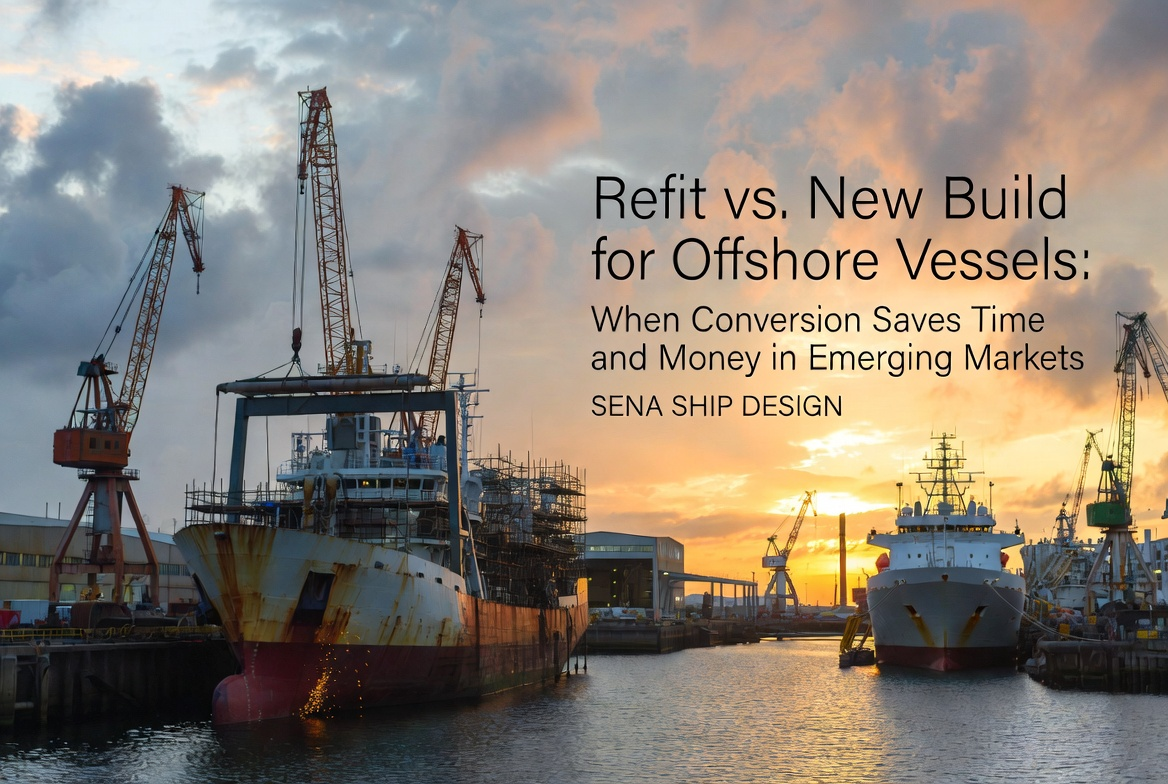
Refit vs. New Build for Offshore Vessels: When Conversion Saves Time and Money in Emerging Markets
In today’s volatile offshore energy and marine logistics sectors, operators in emerging markets face a critical strategic decision: invest in new vessel construction or convert/refit existing assets.
With tightening budgets, fluctuating oil prices, and evolving environmental regulations, refit and conversion strategies are increasingly outperforming new builds in both cost efficiency and delivery timelines.
SENA Ship Design specializes in engineering, retrofit design, and conversion feasibility studies for offshore vessels operating in these fast‑growing markets. This article provides a technical comparison—supported by scientific engineering reasoning—of refit vs. new build and demonstrating why conversion often presents a compelling, cost-effective solution, especially with expert naval architecture and engineering support.
1. Engineering Basis: technical comparison of invest in New Build or convert/refit existing assets.
New Build: The Traditional Path to Modernization
The appeal of a new build is undeniable. It offers the opportunity to integrate the latest technological advancements, optimize hydrodynamics for peak efficiency, and design a vessel precisely tailored to current and future operational requirements.
Advantages:
- Optimized Performance: New designs can leverage cutting-edge Computational Fluid Dynamics (CFD) and Finite Element Analysis (FEA) to achieve superior fuel efficiency, stability, and seakeeping characteristics from inception.
- Latest Technology: Integration of advanced propulsion systems (e.g., hybrid-electric), dynamic positioning (DP) systems, automation, and digital twins for predictive maintenance.
- Extended Lifespan: A new vessel comes with a full design life, reducing immediate concerns about structural fatigue or obsolescence.
- Regulatory Compliance: Designed from the ground up to meet the most current and anticipated international and local regulations.
Disadvantages:
- High Capital Expenditure: New builds represent a substantial upfront investment, often requiring significant financing.
- Extended Lead Times: The design, construction, and commissioning phases can span several years, delaying market entry and revenue generation.
- Market Volatility Risk: Long lead times expose projects to market fluctuations, potentially diminishing the initial business case by the time the vessel is delivered.
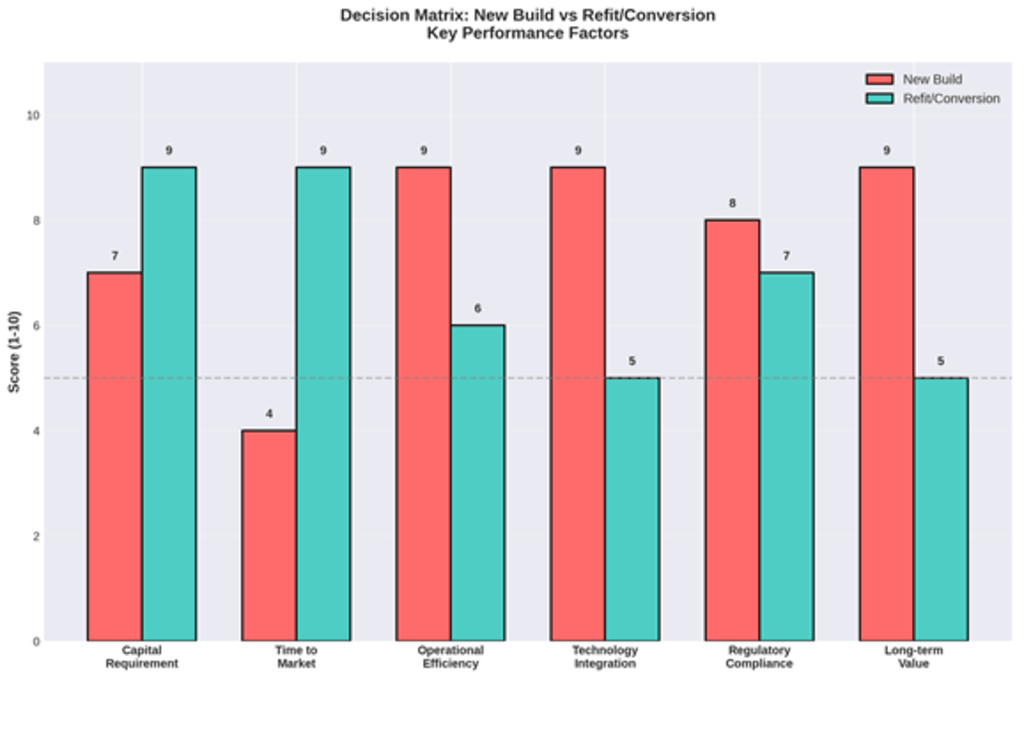
Refit & Conversion: A Strategic Alternative for Agility and Value
Refitting and converting existing offshore vessels offers a compelling alternative, particularly when speed to market and cost-effectiveness are paramount. This approach involves repurposing or upgrading an existing vessel to meet new operational demands or to extend its service life with enhanced capabilities.
Advantages:
- Cost-Effectiveness: Generally, conversions require a lower CAPEX compared to new builds, making them financially attractive for operators in emerging markets.
- Faster Deployment: The timeline for a comprehensive refit is typically significantly shorter than a new build, allowing for quicker asset deployment and revenue generation.
- Sustainability: Reusing an existing hull reduces the environmental footprint associated with new material extraction and construction, aligning with broader sustainability goals.
- Adaptability: Older vessels, often built with robust structures, can be highly adaptable to new roles, such as converting an Anchor Handling Tug Supply (AHTS) vessel into an Offshore Support Vessel (OSV) or a specialized research vessel.
- Known Asset: The operational history and structural integrity of an existing vessel are often well-documented, reducing some of the unknowns inherent in a completely new build.
Technical Considerations in Refit & Conversion:
- Structural Integrity: A thorough marine survey and structural analysis are critical to assess the existing hull’s condition and its capacity to support new equipment or modifications. This often involves advanced FEA to model stress distributions.
- Propulsion and Power Systems: Upgrading engines, generators, and propulsion units can significantly enhance efficiency and reduce emissions. This requires detailed engineering to ensure compatibility and optimal integration.
- Regulatory Compliance: Ensuring the converted vessel meets current class society rules and flag state regulations is paramount. This can involve extensive documentation and approval processes.
- Integration of New Technologies: Incorporating modern navigation, communication, and operational systems requires careful planning to ensure seamless integration with existing infrastructure.
- Stability Analysis: Any significant modification impacts a vessel’s stability characteristics, necessitating detailed hydrostatic and intact/damage stability calculations.
2. Economic Analysis: Quantifying the Savings
From an economic perspective, the decision often boils down to Net Present Value (NPV) and Return on Investment (ROI). While a new build might have a longer depreciable life, the lower initial investment and faster operational readiness of a refit can lead to a more favorable NPV in the short to medium term, especially in volatile markets. The TCO analysis reveals that while refit projects have lower initial capital costs, new build vessels typically demonstrate superior long-term economics due to better operational efficiency, lower maintenance costs, and extended service life. However, for operators with shorter investment horizons (5-10 years) or those prioritizing rapid capital recovery, conversion projects often deliver superior TCO performance.
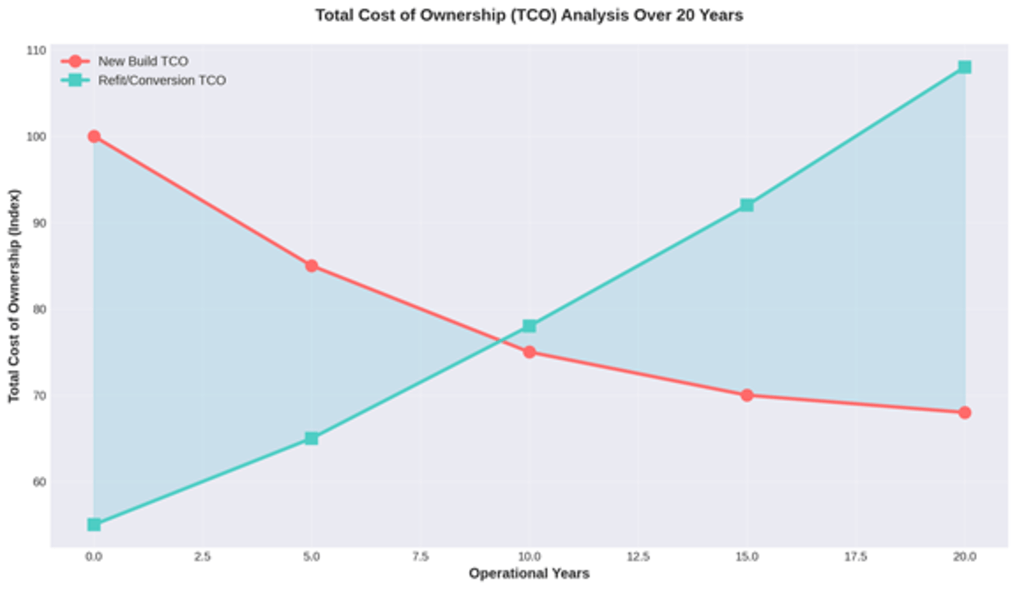
Economic Analysis: Cost Comparison Framework
Capital Cost Comparison
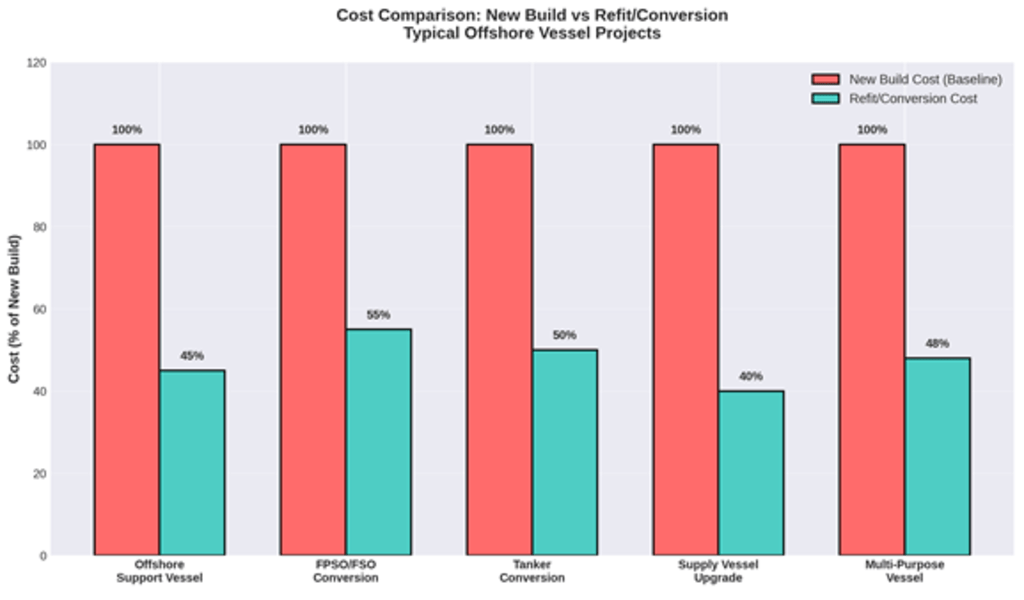
The most compelling economic argument for vessel conversion is the substantial reduction in capital expenditure. For typical offshore support vessels, refit and conversion projects cost 40-60% of equivalent new build projects. This cost advantage stems from several factors:
|
Cost Category
|
New Build
|
Refit/Conversion
|
|---|---|---|
|
Hull & Structure
|
35-40%
|
5-10%
|
|
Propulsion Systems
|
15-20%
|
20-30%
|
|
Electrical & Automation
|
15-18%
|
15-25%
|
|
Accommodation & Outfitting
|
20-25%
|
30-40%
|
|
Project Management & Contingency
|
10-15%
|
15-25%
|
The cost advantage is most pronounced in hull and structural work, where new build requires complete fabrication while conversion utilizes existing hull structure. Labor costs, material costs, and shipyard overhead are all substantially lower in conversion projects, particularly when executed in emerging markets.
Timeline Considerations: Speed to Market
Beyond capital cost, timeline represents a critical competitive factor in offshore vessel acquisition. Market conditions, regulatory requirements, and operational needs often demand rapid deployment of new assets. Conversion projects offer substantial timeline advantages over new build construction.
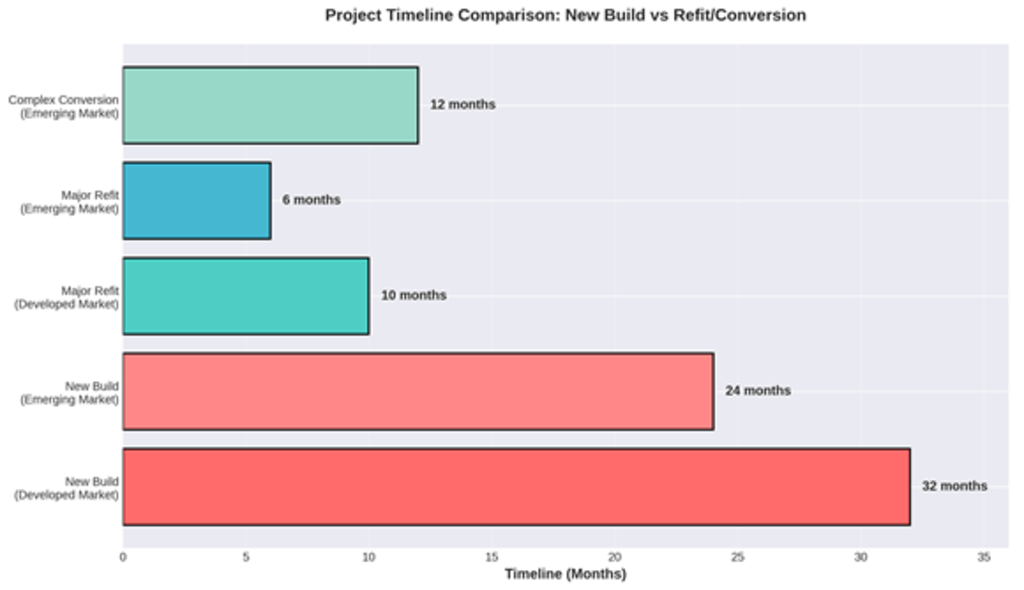
Typical new build projects in developed markets require 32-36 months from order to delivery, with emerging market construction reducing this to 24-28 months. In contrast, major refit and conversion projects typically require 10-18 months in developed markets and 6-12 months in emerging markets. This 50-81% reduction in time-to-market can provide substantial competitive advantages, enabling operators to respond rapidly to market opportunities or contractual requirements.
3. SENA Ship Design: Your Partner in Strategic Vessel Development
At SENA Ship Design, we understand the intricate balance between innovation, efficiency, and cost-effectiveness. Our multi-disciplinary team is uniquely positioned to guide clients through the complexities of both new vessel design and refit/conversion projects, ensuring optimal outcomes for operations in emerging markets.
- Refit & Conversion Design: We specialize in comprehensive refit and conversion design packages, from initial feasibility studies and yard tendering to on-site support and supervision during fabrication. Our expertise ensures that structural modifications, system upgrades, and regulatory compliance are handled with scientific precision.
- Advanced Engineering: Utilizing state-of-the-art CFD and FEA, we conduct detailed studies to predict performance, optimize designs, and ensure the structural integrity of both new and converted vessels. This rigorous analysis is crucial for evaluating the viability and safety of complex modifications.
- Construction Supervision: Our experienced team provides build supervision on behalf of the client, ensuring quality control and adherence to schedules during the entire construction or conversion process.
- Marine Consultancy: We offer independent, professional marine consulting services, providing strategic advice on technical solutions, regulatory compliance, and project feasibility, helping clients make informed decisions.
- Project Management: From concept to delivery, we provide end-to-end project management, overseeing all phases of the shipbuilding process to ensure projects are completed on time and within budget.
Whether upgrading an AHTS, converting a tanker into an offshore production unit, or designing a new specialized vessel, we ensure safe, compliant, cost-efficient solutions tailored to emerging market conditions.