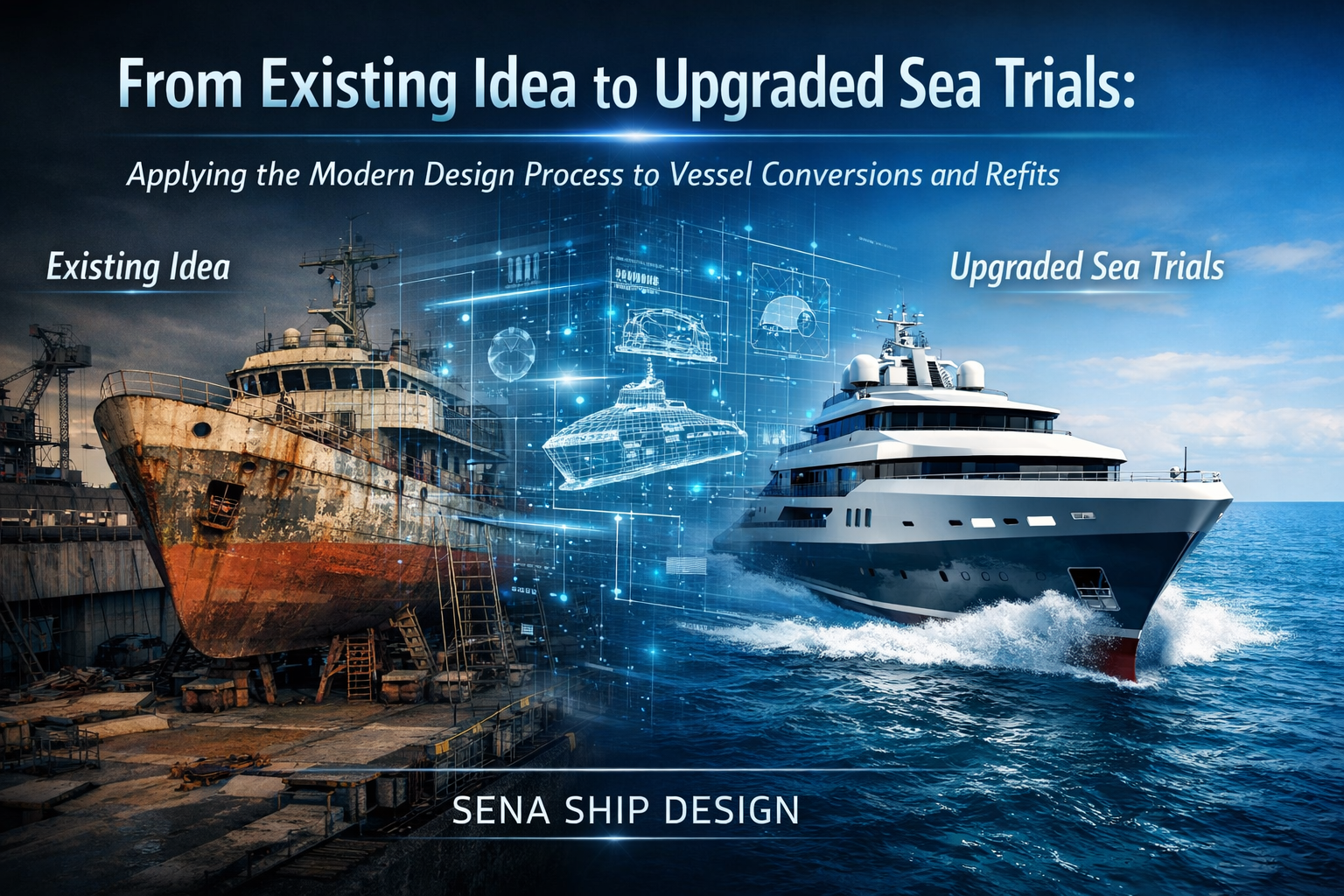
From Existing Idea to Upgraded Sea Trials: Applying the Modern Design Process to Vessel Conversions and Refits A Scientific Analysis by SENA SHIP DESIGN The transformation of existing vessels through conversion and refit projects represents a strategic approach to maritime asset optimization. By applying modern design methodologies—particularly the iterative design spiral approach—operators can achieve cost-effective vessel upgrades while maintaining rigorous technical standards and regulatory compliance. This comprehensive guide explores how contemporary design processes, advanced engineering tools, and systematic project management can accelerate vessel conversions from initial concept through successful sea trials. The modern design spiral methodology enables iterative refinement of conversion designs, ensuring optimal solutions that balance technical performance, regulatory requirements, and economic viability. Key findings from this analysis demonstrate that well-executed conversions can be completed 40-60% faster than new builds, with capital costs reduced by 45-55%, while achieving equivalent or superior performance outcomes. The integration of Computer-Aided Design (CAD), Computational Fluid Dynamics (CFD), and Finite Element Analysis (FEA) enables rapid design iteration and validation, reducing technical risk and ensuring successful sea trials. SENA Ship Design specializes in navigating these complexities, providing comprehensive engineering solutions that ensure efficient, cost-effective, and compliant vessel transformations. 1. Introduction: The Evolution of Vessel Conversions. Vessel conversions and refits represent a mature and economically viable alternative to new construction, particularly in today’s rapidly evolving maritime industry. The strategic conversion of existing vessels—whether for repurposing, life extension, regulatory compliance, or performance enhancement—requires a systematic approach grounded in modern engineering methodologies. The traditional approach to vessel conversions often relied on ad-hoc design modifications and reactive problem-solving. Contemporary best practices, however, apply structured design processes that mirror those used in new ship design, ensuring systematic optimization and risk mitigation throughout the conversion lifecycle. 1.1. Scope of Vessel Conversions Repurposing: Converting vessels from one operational role to another (e.g., tanker to supply vessel, supply vessel to crew transfer vessel) Life Extension: Structural upgrades and system modernization to extend operational life beyond original design life Regulatory Compliance: Upgrades to meet new environmental regulations (MARPOL, EEDI) or safety standards Performance Enhancement: Modifications to improve speed, efficiency, cargo capacity, or operational flexibility Accommodation Refurbishment: Modernization of crew and passenger spaces to meet contemporary standards Alternative Fuel Integration: System modifications to enable operation on LNG, methanol, biofuels, or other alternative fuels 1.2. The Modern Design Process: A Paradigm Shift SENA Ship Design employs a modern, integrated design process that mitigates these traditional challenges by embracing digital technologies and concurrent engineering principles. This approach ensures accuracy, efficiency, and predictability throughout the conversion and refit lifecycle. 1.2.1. Precision Data Capture: 3D Laser Scanning. The foundation of any successful modern conversion project is accurate data capture. Traditional methods of manual measurement are often time-consuming and prone to error. SENA Ship Design utilizes 3D laser scanning to capture the “as-is” state of the vessel with millimeter precision. This process generates a dense point cloud, which is then converted into a highly accurate 3D CAD model. This digital twin of the existing vessel serves as the single source of truth for all subsequent design and engineering activities, eliminating discrepancies and facilitating precise planning. 1.2.2. Advanced Engineering: CFD and FEA for Optimization. With a precise 3D model in hand, advanced engineering tools like Computational Fluid Dynamics (CFD) and Finite Element Analysis (FEA) become indispensable. These simulation tools allow for virtual testing and optimization of proposed modifications: CFD: Used to analyze the hydrodynamic performance of hull modifications, such as adding a bulbous bow, lengthening the vessel, or optimizing propeller design. This ensures that the upgraded vessel achieves desired speed, fuel efficiency, and seakeeping characteristics. FEA: Critical for assessing the structural integrity of the vessel after modifications. Whether adding new equipment, strengthening decks, or reconfiguring internal spaces, FEA identifies stress concentrations and ensures that the new structure can safely withstand operational loads and comply with classification rules. 1.2.3. Streamlined Class Approval. The integration of 3D modeling, CFD, and FEA significantly streamlines the class approval process. Classification societies can directly review and verify the digital models and simulation results, reducing the need for extensive 2D drawing submissions and accelerating the approval timeline. This proactive approach ensures that all modifications meet regulatory requirements from the outset, minimizing costly rework. 2. The Design Spiral Applied to Conversions. The design spiral is a fundamental methodology in modern ship design that applies equally well to vessel conversions. Rather than attempting to finalize all design decisions in a single pass, the design spiral employs an iterative approach where each cycle refines the design based on accumulated knowledge and analysis results. 2.1. Design Spiral Phases. The design spiral for vessel conversions typically comprises four concentric loops, each representing a progressively more detailed design stage: Concept Design (Outer Loop): Feasibility assessment, preliminary layout, initial cost and schedule estimation, regulatory consultation Basic Design (Middle Loop): Detailed system arrangement, structural analysis, regulatory compliance verification, Approval in Principle (AIP) Detailed Design (Inner Loop): Production-ready drawings, complete specifications, construction procedures, detailed cost and schedule Production Design (Innermost Loop): Shipyard-specific optimization, material specifications, fabrication sequences, quality procedures 2.2. The Modern Design Process: A Paradigm Shift 2.2.1. Feasibility Assessment and Planning The feasibility assessment represents the critical first phase of any vessel conversion project. This phase determines whether the conversion is technically viable, economically justified, and capable of meeting regulatory requirements. Key Assessment Components Existing vessel condition survey and structural integrity assessment Evaluation of hull form suitability for intended conversion Analysis of machinery space constraints and equipment compatibility Assessment of regulatory compliance pathways Preliminary cost estimation and financial analysis Schedule estimation and resource planning Identification of key technical risks and mitigation strategies Classification society consultation and approval pathway definition 2.2.2. Concept Design Phase The concept design phase establishes the fundamental parameters of the conversion, including the scope of work, preliminary layouts, and initial performance targets. This phase typically spans 2-4 weeks and involves close collaboration between the owner, designer, and classification society. Concept Design Deliverables Preliminary general arrangement drawings showing proposed modifications Preliminary systems diagrams (propulsion, electrical, HVAC, etc.) Initial weight and stability estimates