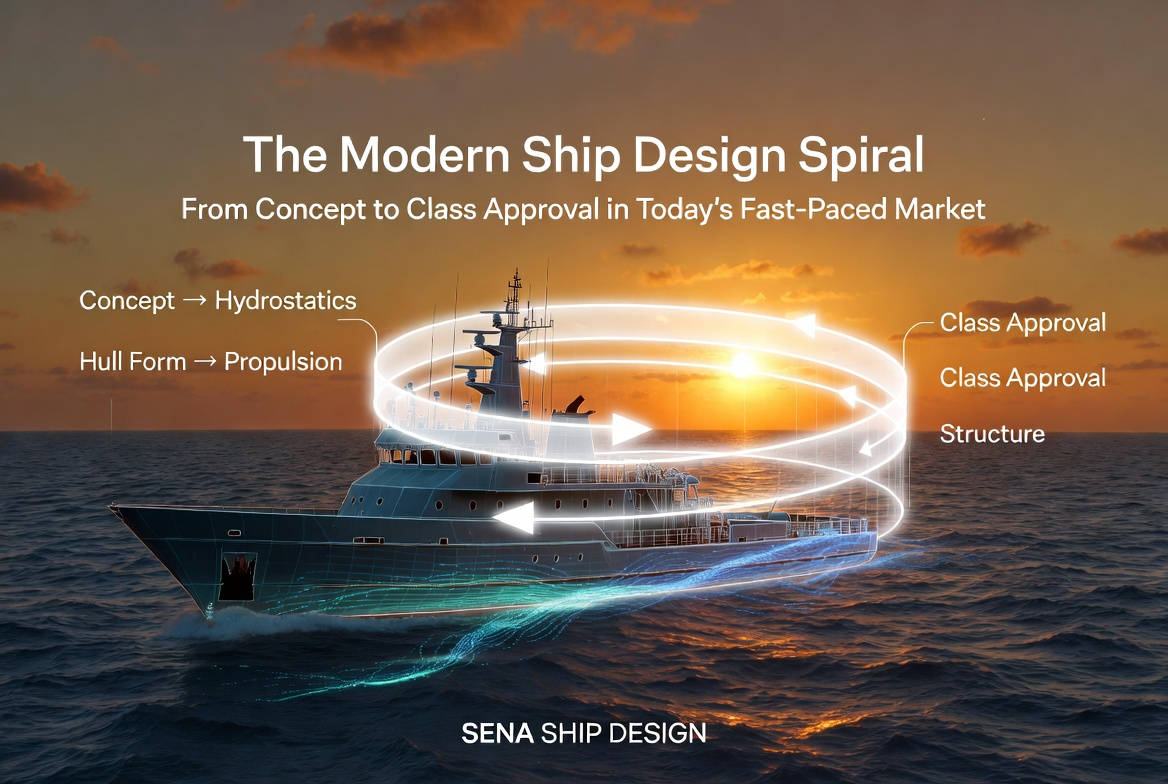
The Modern Ship Design Spiral: From Concept to Class Approval in Today’s Fast-Paced Market
The ship design spiral represents a fundamental paradigm in modern naval architecture, embodying the iterative and cyclical nature of contemporary ship design processes. This comprehensive methodology has evolved significantly since its conceptualization by Evans in 1959, adapting to the demands of today’s fast-paced maritime industry while maintaining its core principle of continuous refinement and optimization.
In an era where time-to-market pressures, regulatory complexity, and sustainability requirements converge, the design spiral provides a structured yet flexible framework for delivering high-quality vessel designs. This blog post explores the modern ship design spiral in scientific detail, examining its four primary phases, the iterative refinement process, classification society approval requirements, and the strategic implementation approaches employed by leading design firms like SENA Ship Design.
The design spiral’s effectiveness lies in its ability to balance multiple competing objectives: cost optimization, schedule adherence, regulatory compliance, and operational performance. Through systematic iteration and multidisciplinary collaboration, naval architects can achieve designs that meet or exceed client expectations while navigating the complex landscape of international maritime regulations and environmental requirements.
1. Introduction to the Modern Ship Design Spiral
The ship design process is fundamentally complex, involving the integration of multiple engineering disciplines, regulatory frameworks, and operational requirements into a coherent whole. The design spiral provides a systematic methodology for managing this complexity through iterative cycles of analysis, refinement, and validation.
Unlike traditional linear design processes, the design spiral recognizes that ship design parameters are inherently interconnected. Hull form affects weight distribution, which influences stability, which impacts propulsion requirements, which affects cost and schedule. The spiral methodology explicitly acknowledges these interdependencies and provides a structured approach for managing them through successive iterations.
Modern ship design operates under unprecedented pressures. Clients demand faster delivery times, lower costs, and enhanced operational capabilities. Simultaneously, regulatory requirements continue to evolve, with increasing emphasis on environmental protection, crew safety, and operational efficiency. The design spiral, when properly executed, enables design teams to navigate these competing demands while maintaining design quality and regulatory compliance.
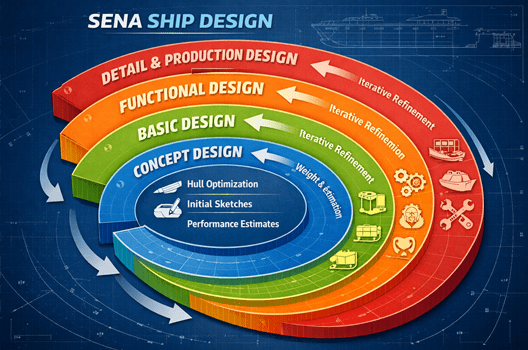
Pillars of the Modern Design Spiral
1. Advanced Digital Tools and Simulation.
At the heart of the modern design spiral are sophisticated digital tools. Computational Fluid Dynamics (CFD) and Finite Element Analysis (FEA) are no longer confined to late-stage validation but are integrated early in the conceptual design phase. This allows for rapid optimization of hull forms, propulsion systems, and structural components, predicting performance and identifying potential issues long before physical prototypes are built.
2. 3D Model-Based Approval (3D MBA).
One of the most significant advancements is the shift towards 3D Model-Based Approval (3D MBA) for class certification. Traditionally, class approval relied heavily on 2D drawings, which could introduce compatibility issues and delays. With 3D MBA, classification societies can directly review and analyze the 3D digital model of a vessel, performing rule checks and calculations with greater accuracy and efficiency. This streamlines the approval process, reduces documentation overhead, and accelerates time-to-market. SENA Ship Design actively utilizes 3D modeling to facilitate seamless class approval, ensuring compliance and efficiency.
3. Integrated Data Environments and Digital Twins.
The modern design spiral thrives on integrated data environments, often culminating in the creation of a Digital Twin. This virtual replica of the vessel is continuously updated with data throughout its lifecycle, from design and construction to operation and maintenance. This “digital thread” ensures that all design decisions are informed by real-world performance data, enabling continuous optimization and predictive maintenance.
2. SENA SHIP DESIGN: Navigating the Modern Spiral
SENA SHIP DESIGN is uniquely positioned to guide clients through the complexities of the modern ship design spiral. Our comprehensive services span the entire lifecycle of vessel development:
1. Concept Design.
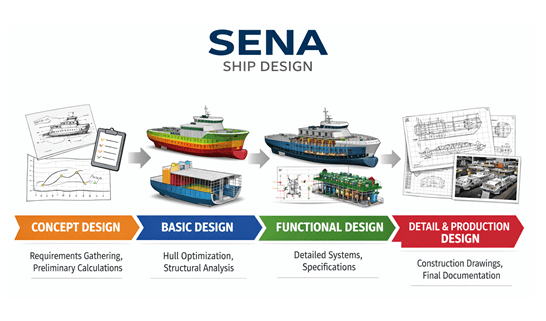
Concept Design represents the initial phase of the design spiral, typically lasting 2-4 weeks. This phase focuses on translating operational requirements into preliminary vessel specifications and identifying the feasibility of the design concept.
During Concept Design, naval architects conduct requirements analysis to understand the vessel’s intended mission, operational profile, and performance expectations. Preliminary calculations establish the vessel’s basic dimensions, displacement, deadweight, and principal characteristics. Initial power and propulsion system sizing is performed based on speed requirements and operational profiles.
2. Contract/Tender Design.
Tender Design, also referred to as Contract Design, typically spans 4-8 weeks and represents a significant refinement of the concept design. This phase establishes detailed specifications for all major systems and obtains preliminary classification society approval.
During Contract Design, hull form optimization is performed using computational fluid dynamics (CFD) analysis to evaluate hydrodynamic characteristics including resistance, pressure distribution, and seakeeping performance. Structural scantling calculations are conducted per classification society rules, establishing the dimensions and specifications of all major structural elements. Weight and center of gravity estimation is performed comprehensively, incorporating all vessel components and systems.
3. Basic/Class Design.
Basic Design, also called Class Design, typically spans 8-16 weeks and represents the comprehensive development of all design details required for construction. This phase produces the detailed drawings and specifications that form the basis for shipyard construction activities.
During Basic Design, detailed structural analysis using Finite Element Analysis (FEA) is performed to verify structural adequacy under all anticipated loading conditions. Complete structural drawing development occurs, with detailed drawings for all hull structure, bulkheads, decks, and superstructure elements. Systems design is finalized for all mechanical, electrical, HVAC, piping, and other vessel systems.
4. Detail/Production Engineering.
Detail & Production Design occurs concurrently with construction and typically spans 12-24 weeks. This phase supports the shipyard’s fabrication and assembly activities, resolving design issues as they arise during construction.
During this phase, detailed production drawings are developed for specific shipyard fabrication sequences. As-built documentation is continuously updated to reflect actual construction activities and any design modifications made during fabrication. Production optimization activities are conducted to improve efficiency and reduce costs. Quality assurance and testing activities are performed to verify compliance with design specifications and regulatory requirements.
Modern Design Challenges and Solutions
Contemporary ship design operates under unprecedented pressures and constraints that require innovative approaches and advanced tools.
Time-to-Market Pressure.
Clients demand faster delivery times, requiring design teams to compress traditional design schedules. Solutions include parallel design activities, early classification society engagement, and advanced digital tools that accelerate analysis and documentation. Modular design approaches enable concurrent design of vessel components.
Regulatory Complexity
Multiple international regulations, classification society requirements, flag state requirements, and port state control requirements create a complex compliance landscape. Solutions include early regulatory engagement, compliance management systems, and experienced regulatory specialists who ensure designs satisfy all applicable requirements.
Sustainability Requirements
IMO environmental targets for 2030 and 2050, combined with increasing environmental regulations, require integration of sustainability considerations into design from the earliest stages. Solutions include alternative fuel integration, energy efficiency optimization, lifecycle environmental assessment, and circular economy design principles.
Digital Transformation
Advanced digital tools including CAD/CAM systems, parametric design tools, AI-assisted optimization, digital twins, and cloud-based collaboration platforms are transforming ship design. These tools enable faster analysis, improved collaboration, and better design optimization.
3. SENA Ship Design: Your Partner in Modern Ship Design
SENA Ship Design is a leading naval architecture and marine engineering firm specializing in comprehensive ship design services from concept through construction supervision. With extensive experience in the modern design spiral methodology, SENA SHIP DESIGN delivers high-quality designs that meet client requirements, regulatory standards, and project schedules.
- Concept Design Development: Comprehensive requirements analysis, preliminary calculations, and feasibility studies to establish design direction and project viability.
- Basic Design & Optimization: Detailed hull form optimization, structural analysis, systems engineering, and preliminary classification society approval.
- Detailed Design & Engineering: Complete design documentation including structural drawings, systems specifications, and construction procedures.
- Classification Society Coordination: Expert coordination with DNV, Lloyd’s Register, ABS, and other classification societies to ensure regulatory compliance and expedite approvals.
- Structural Analysis & Optimization: Advanced FEA analysis, scantling optimization, and structural verification per classification society rules.
- Systems Engineering & Integration: Comprehensive systems design for propulsion, electrical, HVAC, piping, and all vessel systems.
- Construction Supervision: On-site supervision during shipyard construction, quality assurance, and commissioning support.
- Advanced Engineering Services: Specialized services including CFD analysis, noise and vibration analysis, stability optimization, and lifecycle engineering.
Contact SENA SHIP DESIGN today to discuss your ship design requirements and discover how we can help bring your maritime vision to life.
Book a meeting with our team
Ready to launch your next project? Contact SENA SHIP DESIGN today.
© 2025 SENA SHIP DESIGN. All rights reserved. All images are for illustrative purposes; actual deliverables include fully owned IP of the final design.