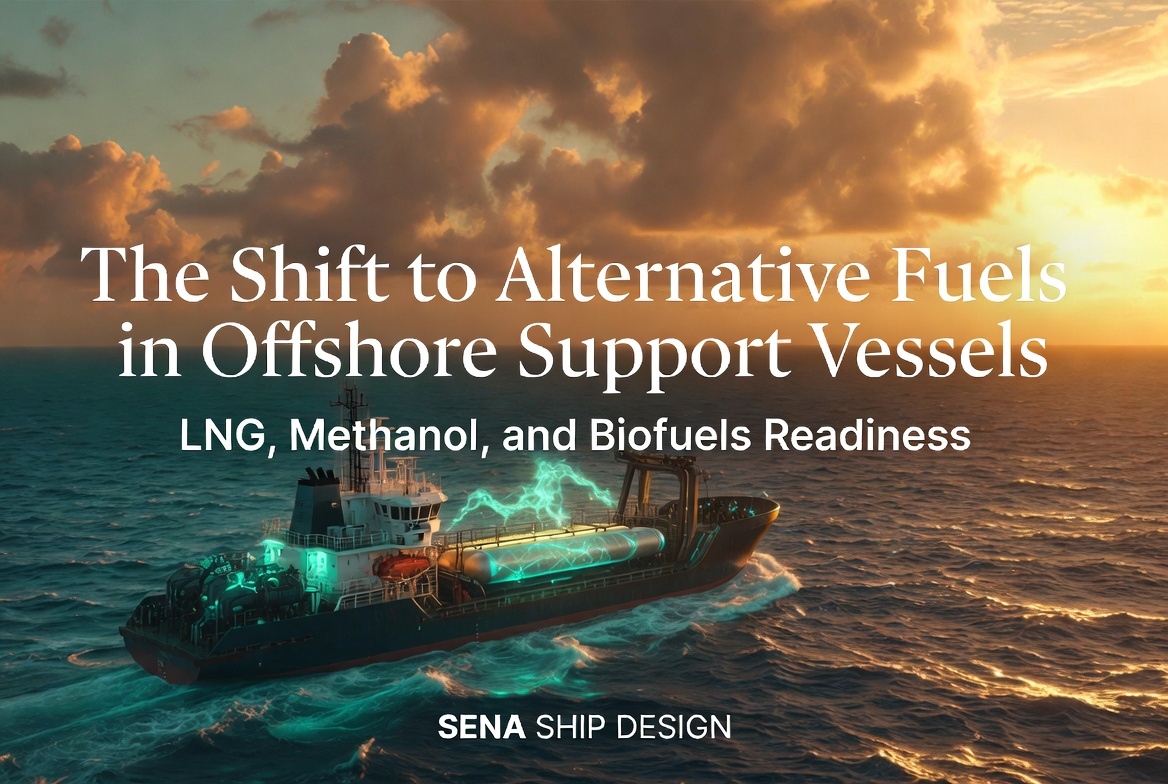
The Shift to Alternative Fuels in Offshore Support Vessels: LNG, Methanol, and Biofuels Readiness A Scientific Analysis by SENA SHIP DESIGN The maritime industry faces unprecedented pressure to decarbonize, driven by increasingly stringent international regulations and climate commitments. Offshore Support Vessels (OSVs), which play a critical role in supporting offshore energy operations, must transition from conventional heavy fuel oil (HFO) to cleaner alternatives. This comprehensive analysis examines three primary alternative fuels—Liquefied Natural Gas (LNG), Methanol, and Biofuels—evaluating their technical feasibility, environmental impact, economic viability, and regulatory compliance for OSV applications. Our findings demonstrate that while LNG offers immediate short-to-medium term benefits with a 20-25% reduction in CO₂ emissions, a multi-fuel approach combining LNG, methanol, and advanced biofuels will be necessary to achieve long-term decarbonization goals. SENA SHIP DESIGN is positioned to support vessel operators and shipowners through comprehensive design, engineering, and consultancy services for alternative fuel integration. 1. Introduction: The Maritime Decarbonization Imperative The International Maritime Organization (IMO) has established ambitious emissions reduction targets: a 40% reduction in greenhouse gas (GHG) emissions by 2030 and a 70% reduction by 2050, compared to 2008 baseline levels. These regulatory mandates, combined with corporate sustainability commitments and investor pressure, have catalyzed a fundamental transformation in marine fuel selection. Offshore Support Vessels, which transport supplies, equipment, and personnel to offshore platforms and renewable energy installations, currently operate predominantly on conventional marine fuels. These vessels face unique operational challenges, including dynamic positioning requirements, variable power demands, and extended periods at sea—factors that significantly influence fuel selection criteria. The transition to alternative fuels is not merely an environmental imperative; it represents a strategic business opportunity. Early adopters of cleaner fuel technologies gain competitive advantages through reduced operational costs, enhanced regulatory compliance, and improved corporate reputation. However, the selection of appropriate alternative fuels requires rigorous technical, environmental, and economic analysis to ensure operational reliability and financial viability. 2. Liquefied Natural Gas (LNG): The Near-Term Solution. Liquefied Natural Gas has emerged as the most mature and widely adopted alternative marine fuel, with established infrastructure, proven engine technology, and regulatory frameworks. LNG is primarily composed of methane (CH₄) and offers significant environmental benefits compared to conventional marine fuels. 2.1. Technical Specifications Parameter Value Volumetric Energy Density ~11 GJ/m³ Specific Energy ~54 MJ/kg Storage Temperature -161°C (cryogenic) Storage Pressure Low pressure (near atmospheric) Energy Content vs MGO 30% of MGO per unit volume 2.2. Environmental Benefits LNG delivers substantial environmental advantages over conventional marine fuels. The primary benefits include: CO₂ Reduction: 20-25% reduction compared to heavy fuel oil (HFO). SOx Emissions: Virtually eliminated (LNG contains no sulfur). NOx Emissions: 80-90% reduction compared to conventional fuels. Particulate Matter: 95%+ reduction in PM emissions. Acoustic Signature: Reduced noise pollution from engine operation. 2.3. Methane Slip: A Critical Challenge Despite its environmental advantages, LNG presents a significant technical challenge: methane slip. This phenomenon occurs when unburned methane escapes during combustion or through the supply chain. Methane possesses a global warming potential (GWP) of 28-36 times that of CO₂ over a 100-year horizon, making methane slip a critical environmental concern. Research indicates that methane slip rates vary significantly across different engine types and operating conditions, with emissions increasing substantially during low-load engine operations. This limitation underscores the necessity for advanced engine technology and continuous operational optimization to maximize the environmental benefits of LNG. 2.4. Regulatory Status and Infrastructure LNG benefits from mature regulatory frameworks, including the IMO‘s International Code of Safety for Ships Using Gases or Other Low-Flashpoint Fuels (IGF Code). The technology has achieved high regulatory maturity, with dual-fuel engines widely available from major manufacturers. Global LNG bunkering infrastructure is expanding rapidly, particularly in Northern Europe, Asia-Pacific, and key maritime hubs. Fuel costs range from $500-$1,000 per ton, reflecting market volatility and regional supply variations. 3. Methanol: The Emerging Alternative Methanol is gaining significant attention as a marine fuel due to its simpler storage requirements, lower technical barriers to implementation, and strong environmental potential. As a liquid at ambient temperature and pressure, methanol offers operational advantages over LNG, particularly for space-constrained vessels like OSVs. 3.1. Technical Characteristics Parameter Value Volumetric Energy Density 15.8 GJ/m³ Specific Energy 19,700 kJ/kg Storage Temperature Liquid at ambient temperature Storage Pressure Low pressure (near atmospheric) Energy Content vs MGO 43% of MGO per unit volume 3.2. Storage and Handling Advantages Methanol’s primary advantage over LNG lies in its storage simplicity. As a liquid at ambient temperature and pressure, methanol requires straightforward double-walled storage tanks without cryogenic insulation systems. This characteristic significantly reduces capital expenditure for vessel conversion and simplifies onboard handling procedures. The fuel is compatible with existing marine fuel infrastructure, requiring only minor modifications to bunkering systems and storage facilities. For OSVs with limited deck space, methanol’s simpler storage architecture provides substantial design flexibility. 3.3. Environmental Profile Methanol’s environmental impact depends critically on its production method. Green methanol, produced from renewable sources through electrolysis or biomass conversion, offers GHG reductions of 60-80% compared to conventional fuels. Grey methanol, derived from fossil fuels, provides more modest benefits. The fuel significantly reduces SOx and NOx emissions compared to conventional marine fuels, contributing to improved air quality in port areas and coastal regions. 3.4. Regulatory Readiness and Market Status Methanol has achieved rapid regulatory advancement. Both 2-stroke and 4-stroke methanol engines are projected to reach full availability by 2024-2025, with regulatory maturity expected before 2026. The IMO has established the International Code of Safety for Ships Using Gases or Other Low-Flashpoint Fuels (II Code) for methanol-fueled vessels. Current fuel costs range from $400-$600 per ton, making methanol economically competitive with LNG. The primary limitation is the lower energy density, requiring approximately 2.3 times larger fuel tanks compared to conventional MGO for equivalent energy content. 4. Biofuels: The Sustainable Long-Term Solution Biofuels represent a transformative pathway toward sustainable maritime decarbonization. Derived from renewable feedstocks including vegetable oils, animal fats, and recycled cooking oil, biofuels can achieve dramatic reductions in lifecycle greenhouse gas emissions while maintaining compatibility with existing marine infrastructure. 4.1. Production and Feedstock Diversity Biofuels are produced through transesterification,
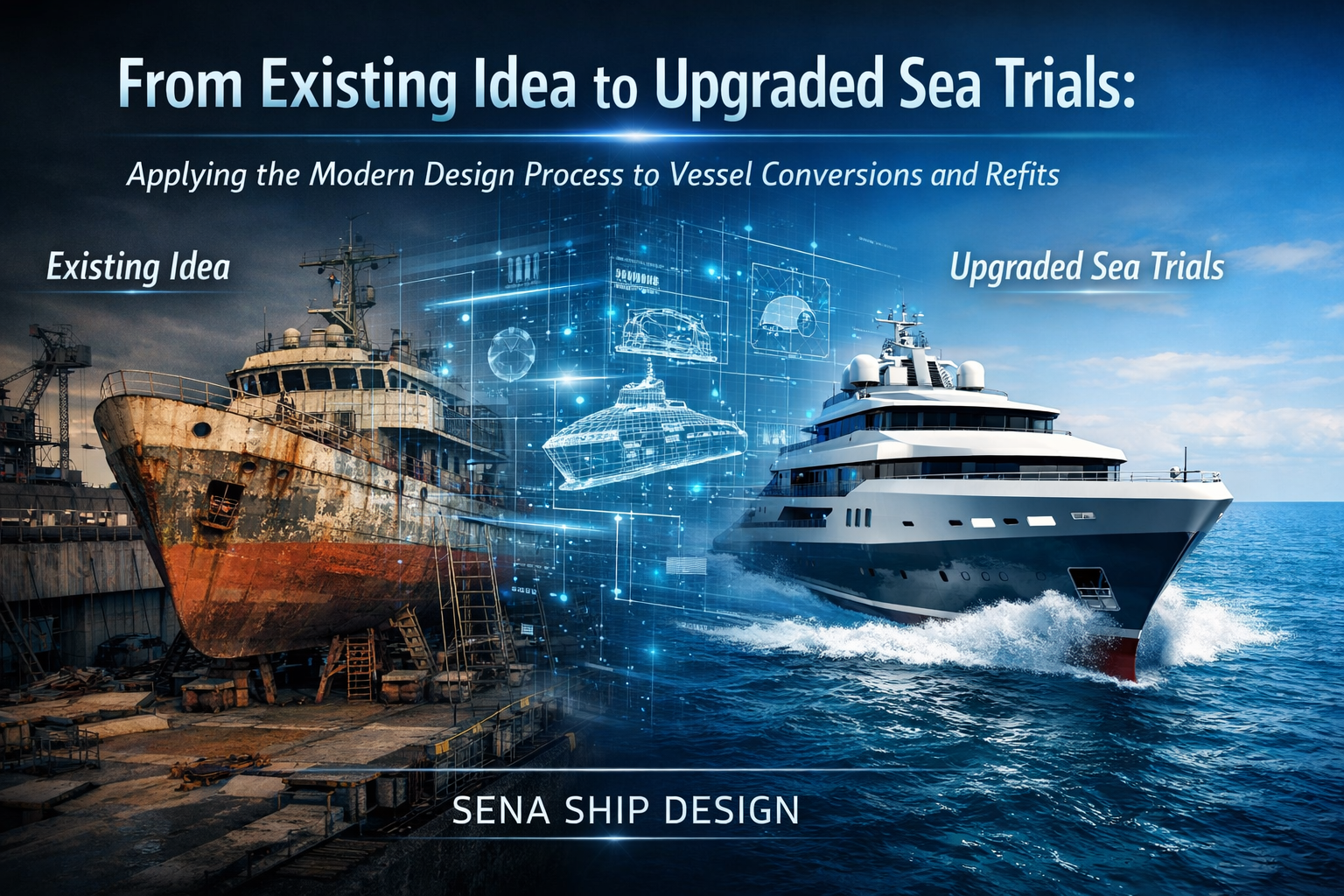
From Existing Idea to Upgraded Sea Trials: Applying the Modern Design Process to Vessel Conversions and Refits
From Existing Idea to Upgraded Sea Trials: Applying the Modern Design Process to Vessel Conversions and Refits A Scientific Analysis by SENA SHIP DESIGN The transformation of existing vessels through conversion and refit projects represents a strategic approach to maritime asset optimization. By applying modern design methodologies—particularly the iterative design spiral approach—operators can achieve cost-effective vessel upgrades while maintaining rigorous technical standards and regulatory compliance. This comprehensive guide explores how contemporary design processes, advanced engineering tools, and systematic project management can accelerate vessel conversions from initial concept through successful sea trials. The modern design spiral methodology enables iterative refinement of conversion designs, ensuring optimal solutions that balance technical performance, regulatory requirements, and economic viability. Key findings from this analysis demonstrate that well-executed conversions can be completed 40-60% faster than new builds, with capital costs reduced by 45-55%, while achieving equivalent or superior performance outcomes. The integration of Computer-Aided Design (CAD), Computational Fluid Dynamics (CFD), and Finite Element Analysis (FEA) enables rapid design iteration and validation, reducing technical risk and ensuring successful sea trials. SENA Ship Design specializes in navigating these complexities, providing comprehensive engineering solutions that ensure efficient, cost-effective, and compliant vessel transformations. 1. Introduction: The Evolution of Vessel Conversions. Vessel conversions and refits represent a mature and economically viable alternative to new construction, particularly in today’s rapidly evolving maritime industry. The strategic conversion of existing vessels—whether for repurposing, life extension, regulatory compliance, or performance enhancement—requires a systematic approach grounded in modern engineering methodologies. The traditional approach to vessel conversions often relied on ad-hoc design modifications and reactive problem-solving. Contemporary best practices, however, apply structured design processes that mirror those used in new ship design, ensuring systematic optimization and risk mitigation throughout the conversion lifecycle. 1.1. Scope of Vessel Conversions Repurposing: Converting vessels from one operational role to another (e.g., tanker to supply vessel, supply vessel to crew transfer vessel) Life Extension: Structural upgrades and system modernization to extend operational life beyond original design life Regulatory Compliance: Upgrades to meet new environmental regulations (MARPOL, EEDI) or safety standards Performance Enhancement: Modifications to improve speed, efficiency, cargo capacity, or operational flexibility Accommodation Refurbishment: Modernization of crew and passenger spaces to meet contemporary standards Alternative Fuel Integration: System modifications to enable operation on LNG, methanol, biofuels, or other alternative fuels 1.2. The Modern Design Process: A Paradigm Shift SENA Ship Design employs a modern, integrated design process that mitigates these traditional challenges by embracing digital technologies and concurrent engineering principles. This approach ensures accuracy, efficiency, and predictability throughout the conversion and refit lifecycle. 1.2.1. Precision Data Capture: 3D Laser Scanning. The foundation of any successful modern conversion project is accurate data capture. Traditional methods of manual measurement are often time-consuming and prone to error. SENA Ship Design utilizes 3D laser scanning to capture the “as-is” state of the vessel with millimeter precision. This process generates a dense point cloud, which is then converted into a highly accurate 3D CAD model. This digital twin of the existing vessel serves as the single source of truth for all subsequent design and engineering activities, eliminating discrepancies and facilitating precise planning. 1.2.2. Advanced Engineering: CFD and FEA for Optimization. With a precise 3D model in hand, advanced engineering tools like Computational Fluid Dynamics (CFD) and Finite Element Analysis (FEA) become indispensable. These simulation tools allow for virtual testing and optimization of proposed modifications: CFD: Used to analyze the hydrodynamic performance of hull modifications, such as adding a bulbous bow, lengthening the vessel, or optimizing propeller design. This ensures that the upgraded vessel achieves desired speed, fuel efficiency, and seakeeping characteristics. FEA: Critical for assessing the structural integrity of the vessel after modifications. Whether adding new equipment, strengthening decks, or reconfiguring internal spaces, FEA identifies stress concentrations and ensures that the new structure can safely withstand operational loads and comply with classification rules. 1.2.3. Streamlined Class Approval. The integration of 3D modeling, CFD, and FEA significantly streamlines the class approval process. Classification societies can directly review and verify the digital models and simulation results, reducing the need for extensive 2D drawing submissions and accelerating the approval timeline. This proactive approach ensures that all modifications meet regulatory requirements from the outset, minimizing costly rework. 2. The Design Spiral Applied to Conversions. The design spiral is a fundamental methodology in modern ship design that applies equally well to vessel conversions. Rather than attempting to finalize all design decisions in a single pass, the design spiral employs an iterative approach where each cycle refines the design based on accumulated knowledge and analysis results. 2.1. Design Spiral Phases. The design spiral for vessel conversions typically comprises four concentric loops, each representing a progressively more detailed design stage: Concept Design (Outer Loop): Feasibility assessment, preliminary layout, initial cost and schedule estimation, regulatory consultation Basic Design (Middle Loop): Detailed system arrangement, structural analysis, regulatory compliance verification, Approval in Principle (AIP) Detailed Design (Inner Loop): Production-ready drawings, complete specifications, construction procedures, detailed cost and schedule Production Design (Innermost Loop): Shipyard-specific optimization, material specifications, fabrication sequences, quality procedures 2.2. The Modern Design Process: A Paradigm Shift 2.2.1. Feasibility Assessment and Planning The feasibility assessment represents the critical first phase of any vessel conversion project. This phase determines whether the conversion is technically viable, economically justified, and capable of meeting regulatory requirements. Key Assessment Components Existing vessel condition survey and structural integrity assessment Evaluation of hull form suitability for intended conversion Analysis of machinery space constraints and equipment compatibility Assessment of regulatory compliance pathways Preliminary cost estimation and financial analysis Schedule estimation and resource planning Identification of key technical risks and mitigation strategies Classification society consultation and approval pathway definition 2.2.2. Concept Design Phase The concept design phase establishes the fundamental parameters of the conversion, including the scope of work, preliminary layouts, and initial performance targets. This phase typically spans 2-4 weeks and involves close collaboration between the owner, designer, and classification society. Concept Design Deliverables Preliminary general arrangement drawings showing proposed modifications Preliminary systems diagrams (propulsion, electrical, HVAC, etc.) Initial weight and stability estimates
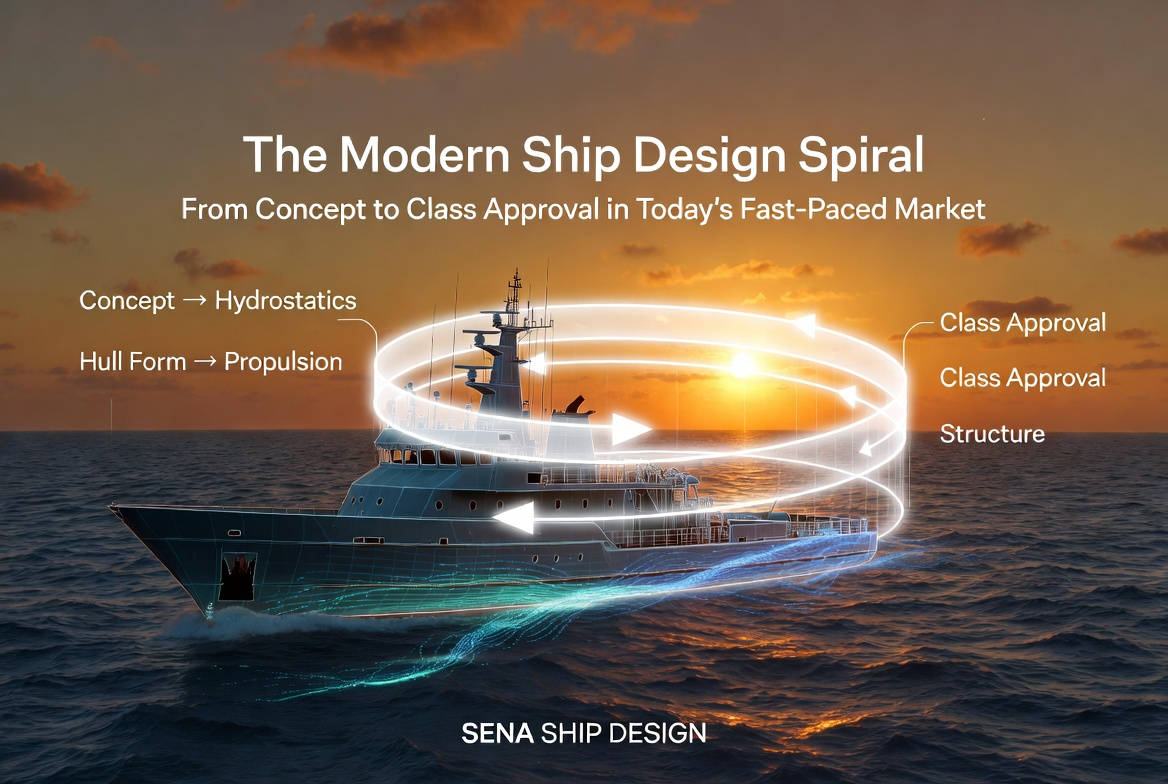
The Modern Ship Design Spiral: From Concept to Class Approval in Today’s Fast-Paced Market
The Modern Ship Design Spiral: From Concept to Class Approval in Today’s Fast-Paced Market A Scientific Analysis by SENA SHIP DESIGN The ship design spiral represents a fundamental paradigm in modern naval architecture, embodying the iterative and cyclical nature of contemporary ship design processes. This comprehensive methodology has evolved significantly since its conceptualization by Evans in 1959, adapting to the demands of today’s fast-paced maritime industry while maintaining its core principle of continuous refinement and optimization. In an era where time-to-market pressures, regulatory complexity, and sustainability requirements converge, the design spiral provides a structured yet flexible framework for delivering high-quality vessel designs. This blog post explores the modern ship design spiral in scientific detail, examining its four primary phases, the iterative refinement process, classification society approval requirements, and the strategic implementation approaches employed by leading design firms like SENA Ship Design. The design spiral’s effectiveness lies in its ability to balance multiple competing objectives: cost optimization, schedule adherence, regulatory compliance, and operational performance. Through systematic iteration and multidisciplinary collaboration, naval architects can achieve designs that meet or exceed client expectations while navigating the complex landscape of international maritime regulations and environmental requirements. 1. Introduction to the Modern Ship Design Spiral The ship design process is fundamentally complex, involving the integration of multiple engineering disciplines, regulatory frameworks, and operational requirements into a coherent whole. The design spiral provides a systematic methodology for managing this complexity through iterative cycles of analysis, refinement, and validation. Unlike traditional linear design processes, the design spiral recognizes that ship design parameters are inherently interconnected. Hull form affects weight distribution, which influences stability, which impacts propulsion requirements, which affects cost and schedule. The spiral methodology explicitly acknowledges these interdependencies and provides a structured approach for managing them through successive iterations. Modern ship design operates under unprecedented pressures. Clients demand faster delivery times, lower costs, and enhanced operational capabilities. Simultaneously, regulatory requirements continue to evolve, with increasing emphasis on environmental protection, crew safety, and operational efficiency. The design spiral, when properly executed, enables design teams to navigate these competing demands while maintaining design quality and regulatory compliance. Pillars of the Modern Design Spiral 1. Advanced Digital Tools and Simulation. At the heart of the modern design spiral are sophisticated digital tools. Computational Fluid Dynamics (CFD) and Finite Element Analysis (FEA) are no longer confined to late-stage validation but are integrated early in the conceptual design phase. This allows for rapid optimization of hull forms, propulsion systems, and structural components, predicting performance and identifying potential issues long before physical prototypes are built. 2. 3D Model-Based Approval (3D MBA). One of the most significant advancements is the shift towards 3D Model-Based Approval (3D MBA) for class certification. Traditionally, class approval relied heavily on 2D drawings, which could introduce compatibility issues and delays. With 3D MBA, classification societies can directly review and analyze the 3D digital model of a vessel, performing rule checks and calculations with greater accuracy and efficiency. This streamlines the approval process, reduces documentation overhead, and accelerates time-to-market. SENA Ship Design actively utilizes 3D modeling to facilitate seamless class approval, ensuring compliance and efficiency. 3. Integrated Data Environments and Digital Twins. The modern design spiral thrives on integrated data environments, often culminating in the creation of a Digital Twin. This virtual replica of the vessel is continuously updated with data throughout its lifecycle, from design and construction to operation and maintenance. This “digital thread” ensures that all design decisions are informed by real-world performance data, enabling continuous optimization and predictive maintenance. 2. SENA SHIP DESIGN: Navigating the Modern Spiral SENA SHIP DESIGN is uniquely positioned to guide clients through the complexities of the modern ship design spiral. Our comprehensive services span the entire lifecycle of vessel development: 1. Concept Design. Concept Design represents the initial phase of the design spiral, typically lasting 2-4 weeks. This phase focuses on translating operational requirements into preliminary vessel specifications and identifying the feasibility of the design concept. During Concept Design, naval architects conduct requirements analysis to understand the vessel’s intended mission, operational profile, and performance expectations. Preliminary calculations establish the vessel’s basic dimensions, displacement, deadweight, and principal characteristics. Initial power and propulsion system sizing is performed based on speed requirements and operational profiles. 2. Contract/Tender Design. Tender Design, also referred to as Contract Design, typically spans 4-8 weeks and represents a significant refinement of the concept design. This phase establishes detailed specifications for all major systems and obtains preliminary classification society approval. During Contract Design, hull form optimization is performed using computational fluid dynamics (CFD) analysis to evaluate hydrodynamic characteristics including resistance, pressure distribution, and seakeeping performance. Structural scantling calculations are conducted per classification society rules, establishing the dimensions and specifications of all major structural elements. Weight and center of gravity estimation is performed comprehensively, incorporating all vessel components and systems. 3. Basic/Class Design. Basic Design, also called Class Design, typically spans 8-16 weeks and represents the comprehensive development of all design details required for construction. This phase produces the detailed drawings and specifications that form the basis for shipyard construction activities. During Basic Design, detailed structural analysis using Finite Element Analysis (FEA) is performed to verify structural adequacy under all anticipated loading conditions. Complete structural drawing development occurs, with detailed drawings for all hull structure, bulkheads, decks, and superstructure elements. Systems design is finalized for all mechanical, electrical, HVAC, piping, and other vessel systems. 4. Detail/Production Engineering. Detail & Production Design occurs concurrently with construction and typically spans 12-24 weeks. This phase supports the shipyard’s fabrication and assembly activities, resolving design issues as they arise during construction. During this phase, detailed production drawings are developed for specific shipyard fabrication sequences. As-built documentation is continuously updated to reflect actual construction activities and any design modifications made during fabrication. Production optimization activities are conducted to improve efficiency and reduce costs. Quality assurance and testing activities are performed to verify compliance with design specifications and regulatory requirements. Modern Design Challenges and Solutions Contemporary ship design operates under unprecedented pressures and constraints that require